In an average year, the Warren area gets its first freezing night around October 27 and sees 119.5 nights at or below 32°F, according to NOAA's 1991–2020 climate normals for Detroit Metro Airport. That calendar decides when mosquitoes fly, when termites swarm and when mice move indoors. Bed bugs follow a different calendar, set by travel and holiday guests rather than weather. This guide lines up the climate data with published pest activity windows so you can see what each month brings to a Warren home.
How to read this guide: BedBugTreatmentWarrenMI.com is a referral line for bed bug help. The climate figures come from NOAA's nearest long-record station, Detroit Metro Airport (DTW), about 25 miles southwest of Warren. Pest data comes from Michigan health agencies, Michigan State University, national surveys and pest company rankings, each linked to its source.
- Detroit Metro Airport averages 50.6°F for the year, from 25.8°F in January to 74.1°F in July (NOAA NCEI normals).
- The median first fall freeze is October 27, the median first hard freeze (28°F) is November 7, and the median last spring freeze is April 20 (NOAA NCEI normals).
- Mosquitoes can fly whenever it is 50°F or warmer, an MSU entomologist says; the area's monthly mean stays at or above 50°F from May through October (Michigan Public).
- West Nile risk in Michigan peaks in August and September (MDHHS); Michigan has 35 human West Nile cases so far in 2026, 5 of them in Macomb County (MDHHS Weekly Arbovirus Summary).
- Detroit ranks #4 on Orkin's 2026 Top Mosquito Cities list, up from #5 in 2025 (Orkin).
- Professional mosquito control costs $80–$150 per visit or $350–$1,000 per season (HomeGuide).
- Blacklegged ticks are active in Michigan from March to November (MDHHS Lyme risk map), and Michigan Lyme cases rose 168% from 452 in 2020 to 1,215 in 2024 (MDHHS).
- Macomb County recorded 21 confirmed and probable Lyme cases in 2025, 75% above its 2022–2024 average of 12 (Macomb County Health Department).
- Michigan's main termite, the eastern subterranean termite, typically swarms during the day from March to May (Orkin).
- Yellowjacket colonies peak around early September with 800–3,000 workers per nest (MSU).
- Rodents invade an estimated 21 million U.S. homes each winter, and 24% of homeowners report mice infestations in winter (NPMA).
- Detroit is #6 on Orkin's 2026 Rattiest Cities list (Orkin) and entered Terminix's rodent top 10 for the first time (PCT).
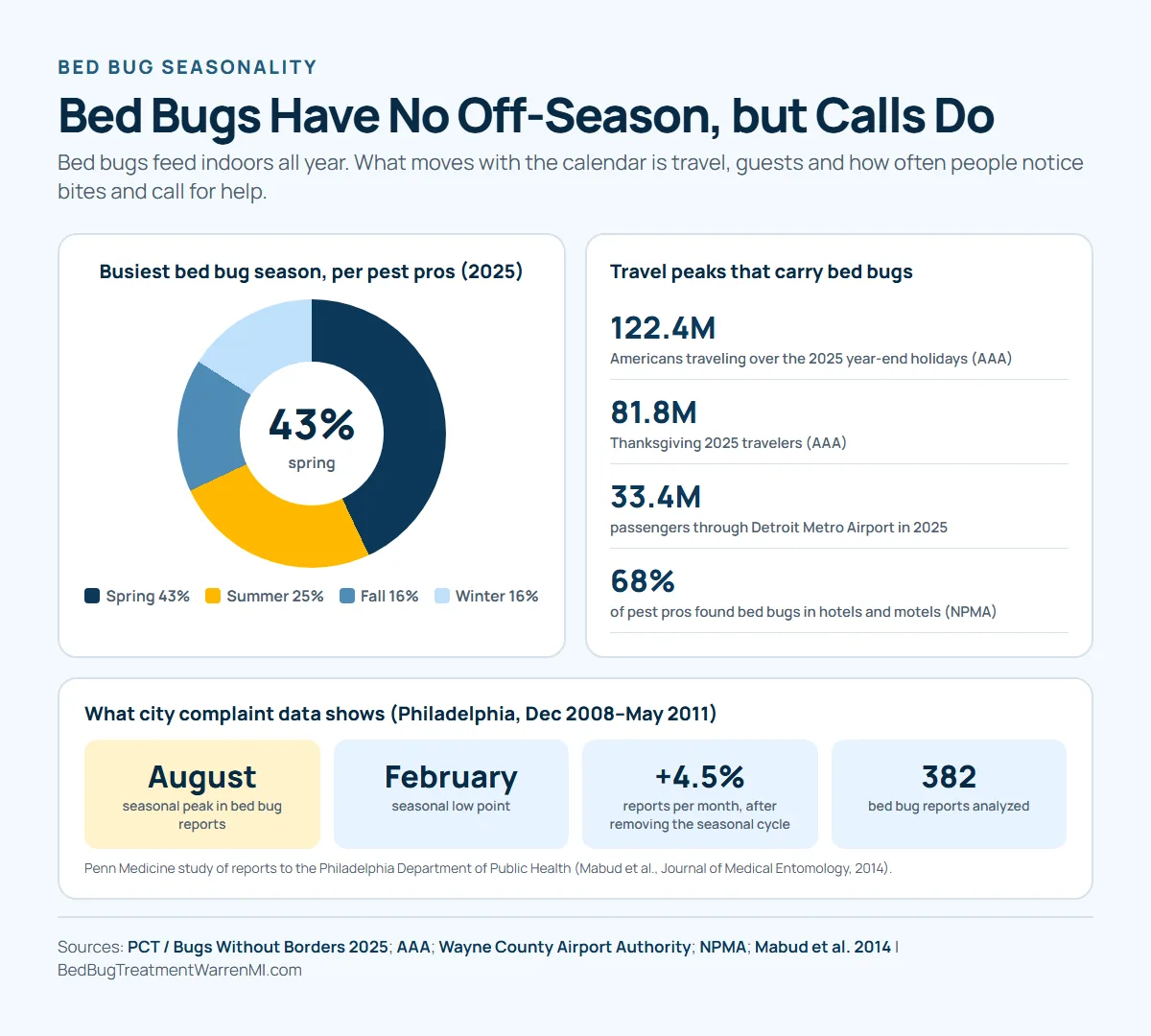
- In a 2025 survey, 43% of pest professionals named spring as their busiest bed bug season, ahead of summer at 25% (PCT, Bugs Without Borders 2025).
- Philadelphia's bed bug reports peaked each August and bottomed out each February (Mabud et al., Journal of Medical Entomology).
- AAA projected a record 122.4 million Americans would travel over the 2025 year-end holidays (AAA).
1. The 12-Month Warren Pest Pressure Matrix
The matrix below sets NOAA's monthly normals for Detroit Metro Airport next to the pest activity windows published by Michigan's health department, the Macomb County Health Department, MSU and pest industry data. Temperatures, freezing nights and rainfall are NOAA's 1991–2020 normals. Humidity is the mean relative humidity we calculated from NOAA's hourly temperature and dew point normals for the same station.
| Month | Avg temp (high / low) | Humidity | Nights ≤32°F | Rain days* | What surges in Warren |
|---|---|---|---|---|---|
| Jan | 25.8°F (32.3 / 19.2) | 74% | 27.2 | 5.9 | Rodents indoorsBed bugs (seasonal low) |
| Feb | 28.0°F (35.2 / 20.8) | 70% | 25.1 | 5.3 | Rodents indoorsBed bugs (seasonal low) |
| Mar | 37.2°F (45.9 / 28.6) | 64% | 21.0 | 6.1 | Rodents indoorsBed bugs (spring calls)Ticks startEarly termite swarms |
| Apr | 48.9°F (58.7 / 39.1) | 59% | 6.2 | 7.2 | Termite swarmsTicksBed bugsFirst mosquitoes |
| May | 60.3°F (70.3 / 50.2) | 62% | 0.3 | 7.7 | Termite swarmsTicksMosquitoesBed bugs |
| Jun | 69.9°F (79.7 / 60.2) | 64% | 0 | 6.3 | TicksMosquitoesBed bugs |
| Jul | 74.1°F (83.7 / 64.4) | 66% | 0 | 6.4 | TicksBed bugs (travel)MosquitoesWasps building |
| Aug | 72.3°F (81.4 / 63.2) | 69% | 0 | 6.1 | Mosquitoes (West Nile)Bed bugs (peak reports)TicksYellowjackets |
| Sep | 64.9°F (74.4 / 55.5) | 70% | 0 | 5.9 | Mosquitoes (West Nile)YellowjacketsFall invadersTicks |
| Oct | 53.0°F (62.0 / 44.0) | 70% | 1.9 | 5.6 | Fall invadersRodents move inYellowjacketsLast mosquitoes |
| Nov | 41.2°F (48.6 / 33.9) | 71% | 13.7 | 5.6 | Rodents indoorsBed bugs (holiday travel)Ticks on mild days |
| Dec | 31.3°F (37.2 / 25.3) | 75% | 24.2 | 5.4 | Rodents indoorsBed bugs (holiday travel) |
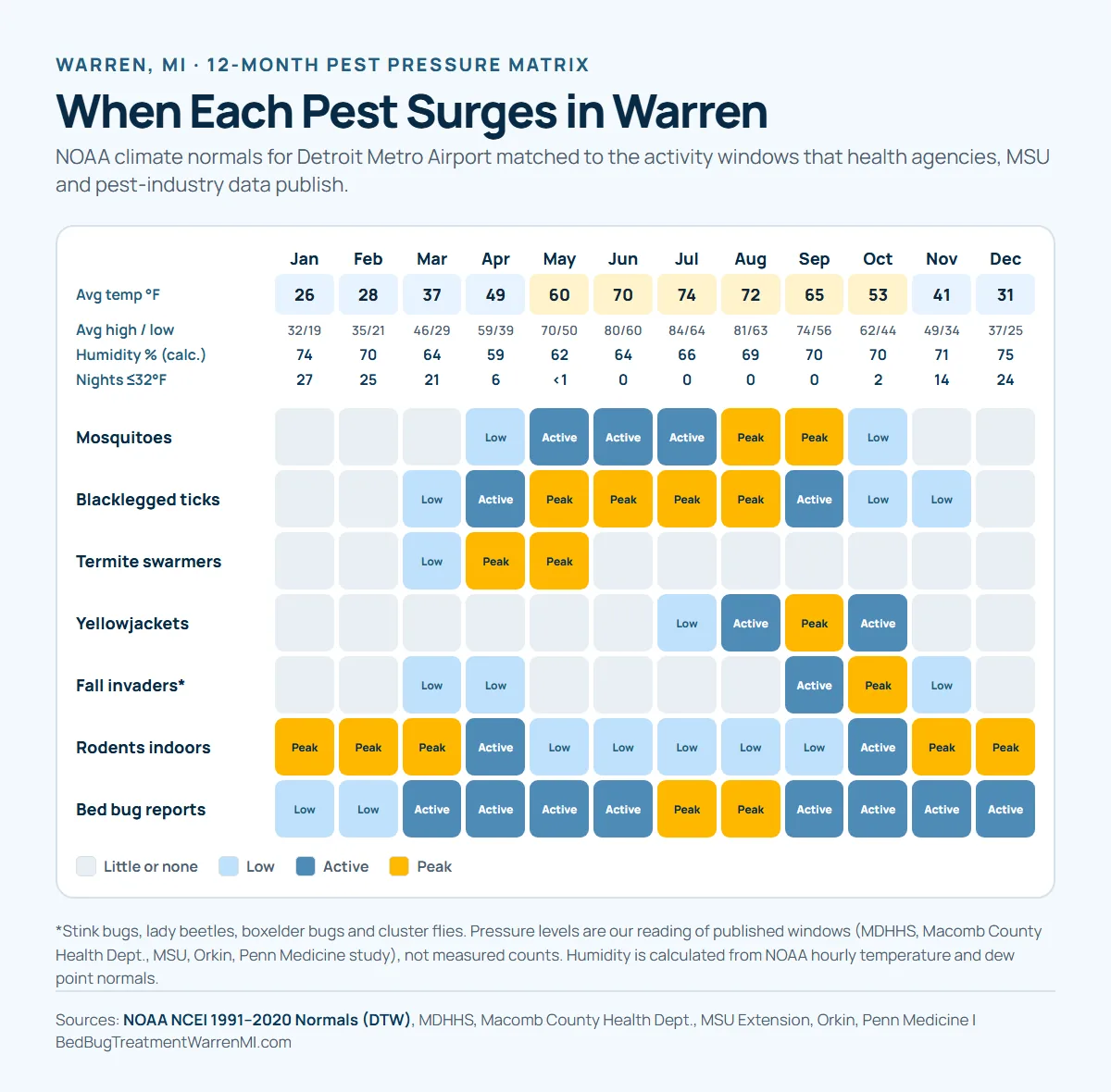
Two patterns stand out. Outdoor pests (mosquitoes, ticks, termites and wasps) are packed into the roughly 188 days between the last spring freeze and the first fall freeze. Rodents run the other way and press indoors once freezing nights start to stack up in November. Bed bugs are the exception to both, because they live indoors at room temperature all year; their curve follows travel, guests and how often people notice bites.
2. Warren's Climate by the Numbers: NOAA Monthly Normals
Warren does not have its own long-record NOAA station, so the closest reliable climate normals come from Detroit Metro Airport. The airport sits in the same flat, humid Great Lakes climate, so its monthly numbers are a good guide to when Warren warms up, dries out and freezes.
| Climate metric (DTW, 1991–2020) | Value | Source |
|---|---|---|
| Annual mean temperature | 50.6°F | NOAA NCEI |
| Coldest month (January) mean / average low | 25.8°F / 19.2°F | NOAA NCEI |
| Warmest month (July) mean / average high | 74.1°F / 83.7°F | NOAA NCEI |
| Annual precipitation | 34.32 in | NOAA NCEI |
| Wettest month | May, 3.72 in (7.7 days with 0.10 in+) | NOAA NCEI |
| Annual snowfall | 45.0 in (14.0 in January) | NOAA NCEI |
| Nights at or below 32°F per year | 119.5 | NOAA NCEI |
| Days at 90°F or hotter per year | 13.0 (5.3 in July) | NOAA NCEI |
| Median freeze-free growing season | 188 days | NOAA NCEI |
| Heating / cooling degree days | 6,067 / 847 | NOAA NCEI |
| Most humid months (calculated mean RH) | December 75%, January 74% | Calculated from NOAA hourly normals |
| Muggiest month (highest mean dew point) | July, 61.5°F | NOAA hourly normals |
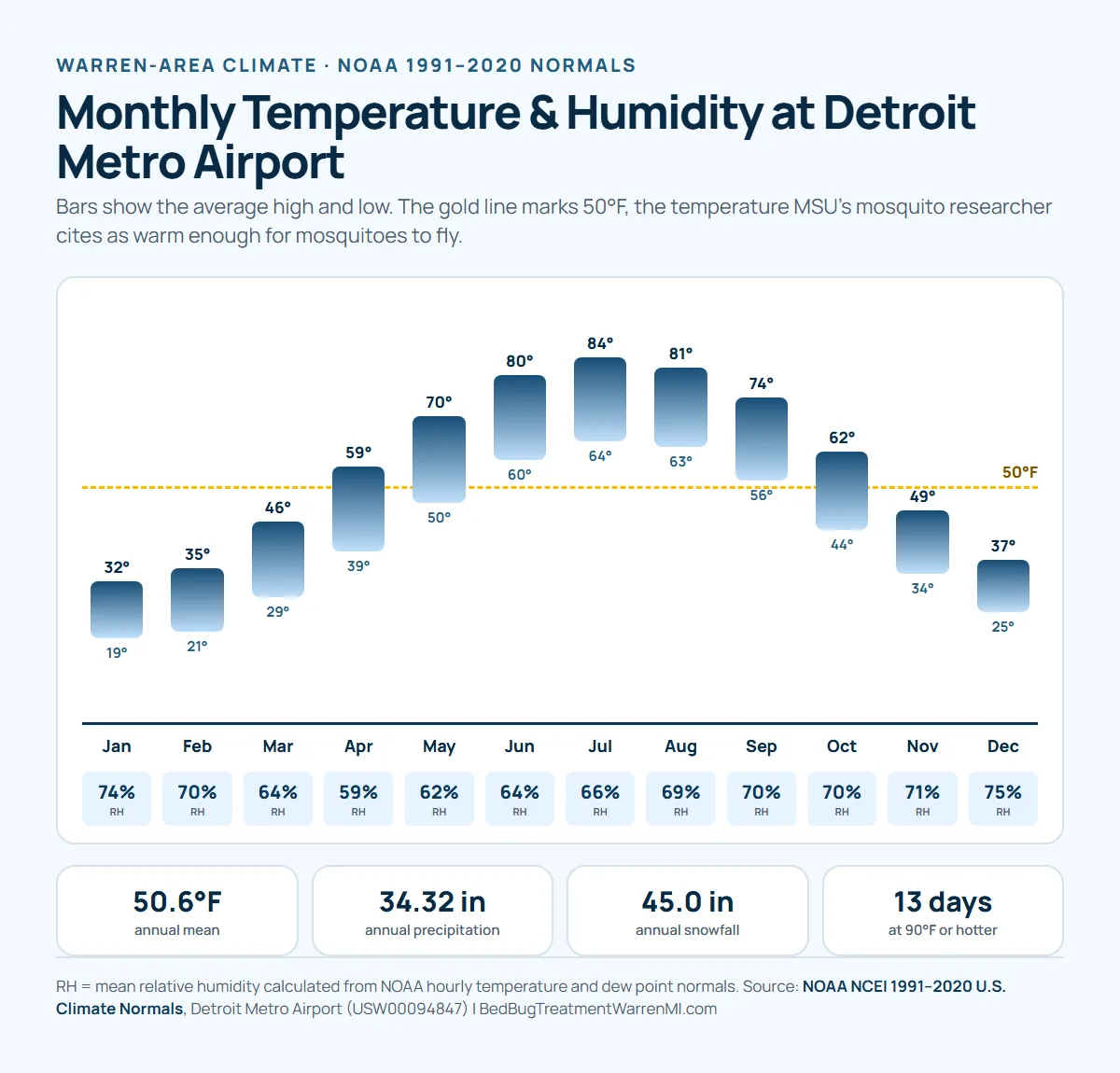
Humidity matters less here than in the South, but it still shapes the calendar. Warm, wet weeks in late spring set up termite and ant swarms and fill the standing water that mosquitoes breed in; May is both the wettest month and the month with the most rainy days. The calculated humidity is highest in late fall and winter, when cold air sits close to its dew point, which is also the stretch when mice are pressing indoors.
3. The Most Common Pests in Warren and the Detroit Metro
No agency counts pest calls city by city, but the national pest companies publish rankings based on how many treatments they perform in each metro area. The Detroit metro, which includes Warren, now sits near the top of all of them: bed bugs, mosquitoes and rodents.
| Ranking | Detroit | Data period | Source |
|---|---|---|---|
| Orkin Top 50 Bed Bug Cities 2026 | #3 | May 12, 2025 – May 12, 2026 | Orkin |
| Orkin Top 50 Mosquito Cities 2026 | #4 (up 1) | Mar 18, 2025 – Mar 18, 2026 | Orkin |
| Orkin Top 50 Mosquito Cities 2025 | #5 (first top-5 appearance) | Apr 1, 2024 – Mar 31, 2025 | Orkin |
| Orkin Rattiest Cities 2026 | #6 (up 1) | Aug 9, 2025 – Aug 9, 2026 | Orkin |
| Terminix Most Rodent-Infested Cities | #10 (first time in top 10) | 2025 service data | PCT / Terminix |
| Grand Rapids / Flint, 2026 bed bug list | #10 / #20 | May 2025 – May 2026 | Orkin |
| Grand Rapids / Flint, 2026 mosquito list | #28 / #33 | Mar 2025 – Mar 2026 | Orkin |
| Grand Rapids / Flint, 2026 rat list | #28 / #48 | Aug 2025 – Aug 2026 | Orkin |
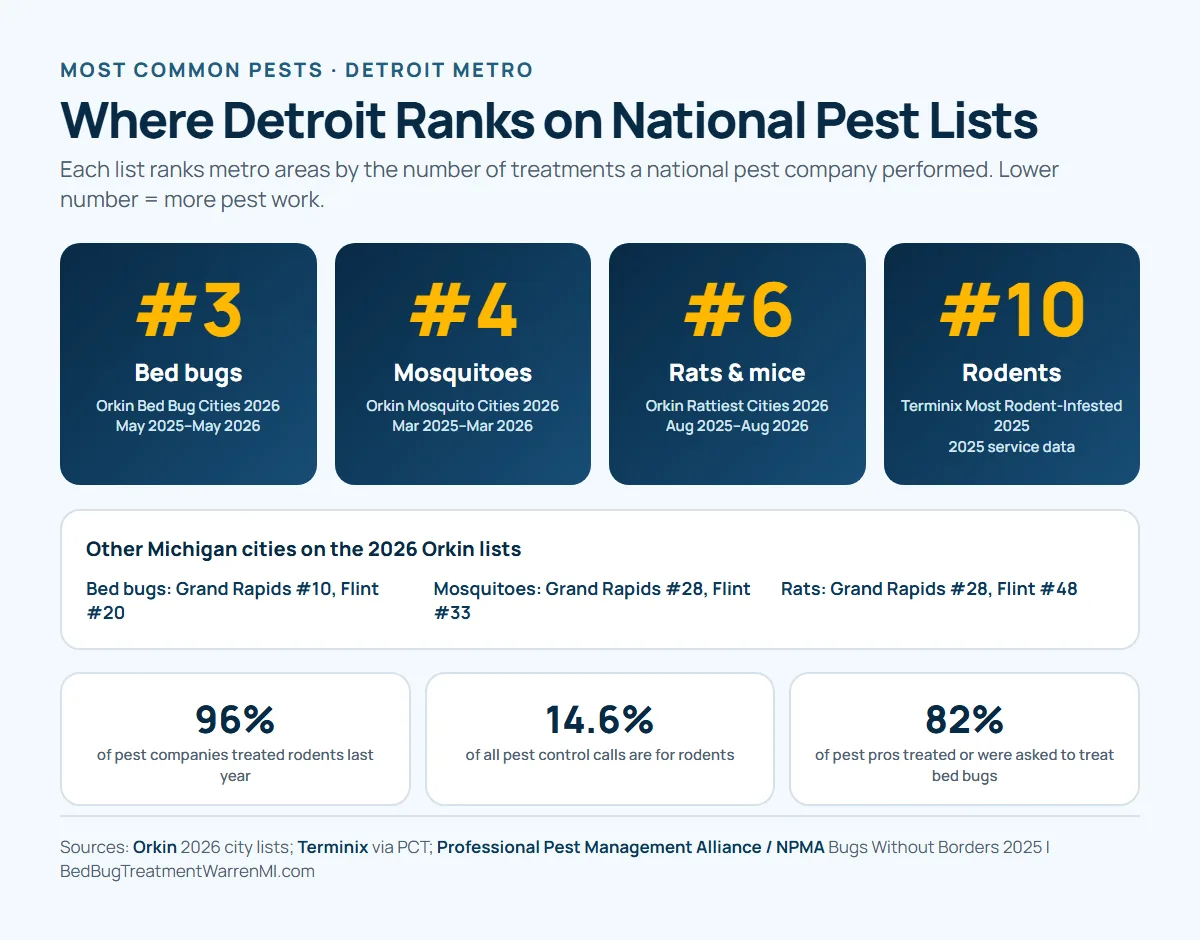
Nationally, the pest professionals surveyed for the 2025 Bugs Without Borders study say rodents are the most commonly treated pest: 96% of companies handled them in the past year, and rodents made up 14.6% of all pest control calls. Only 11% of homeowners call for preventive rodent control, and only 23% book a preventive termite inspection (Professional Pest Management Alliance). The same survey found that 42% of pest professionals saw invasive species pressure rise, with brown marmorated stink bugs treated by 43% of them (PCT).
For a Warren household, that means the most common problems follow the seasons: mosquitoes and ticks in summer, stinging insects and fall invaders in early autumn, rodents in winter. Bed bugs, the one pest on all three Detroit lists that does not care about the weather, are covered in section 9.
4. When Is Mosquito Season in Michigan?
Mosquito season in Michigan is set by temperature. "If it's 50 degrees Fahrenheit or higher, that is sufficient temperature for the insects to be able to fly," MSU entomologist Ned Walker told Michigan Public, adding that the fall season is lengthening and that 2025 activity was expected to continue into October (Michigan Public). At Detroit Metro Airport, the monthly mean first passes 50°F in May and stays above it through October, and average overnight lows stay at or above 50°F from May (50.2°F) through September (55.5°F).
| Mosquito metric | Value | Source |
|---|---|---|
| Temperature at which mosquitoes can fly | 50°F or higher | Michigan Public (MSU) |
| Months with a mean of 50°F+ at DTW | May–October (6) | NOAA NCEI |
| Peak West Nile risk in Michigan | August–September | MDHHS |
| Mosquito species in Michigan | nearly 60 (MSU); about 70 native species (MSU's Walker) | MSU Extension; Michigan Public |
| Human West Nile cases, Michigan 2026 (as of Nov 6) | 35 | MDHHS |
| Human West Nile cases in Macomb County, 2026 | 5 | MDHHS |
| All human mosquito-borne (arbovirus) cases, Michigan 2026 | 37 (35 WNV, 1 EEE, 1 Jamestown Canyon) | MDHHS |
| Mosquito pools tested / mosquitoes tested, 2026 | 7,400 / 115,574 | MDHHS |
| West Nile-positive pools statewide / in Macomb | 120 / 7 | MDHHS |
| West Nile status in Macomb County | Endemic, with more cases in summer and fall | Macomb County Health Department |
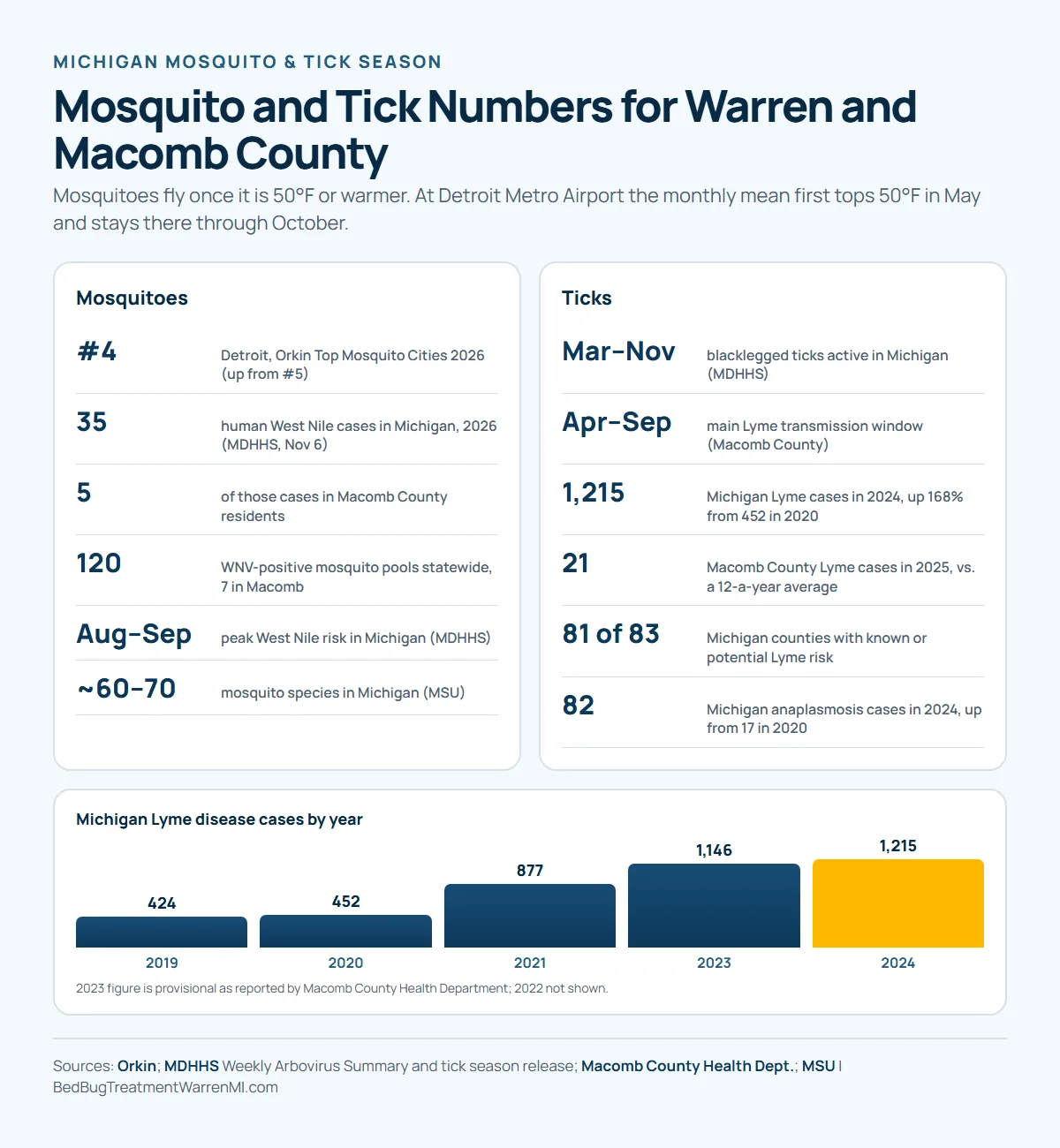
MSU splits Michigan mosquitoes into two groups. Spring mosquitoes hatch from snowmelt pools and produce one generation a year; summer mosquitoes breed again and again as long as there is standing water, and some floodwater species can go from egg to adult in as little as five days in hot weather (MSU Extension). That is why a wet stretch in June or July can bring a sudden surge, and why the West Nile peak lands late, in August and September, after several summer generations.
5. What Mosquito Barrier Treatments Cost per Season
Most yard mosquito programs are barrier sprays applied to shrubs and shady resting spots every few weeks. Published price guides put them in a fairly tight per-visit band, but the season total depends on how many visits your season needs. One correction to a figure that circulates widely: the season range in current cost guides runs higher than $350–$700. HomeGuide puts it at $350–$1,000, and Angi lists $600–$1,200 a year for a seasonal package.
| Mosquito control cost | Price | Source |
|---|---|---|
| Typical visit, mosquito control company | $80–$150 | HomeGuide |
| Typical season | $350–$1,000 | HomeGuide |
| Barrier spray, per treatment | $125–$165 (HomeGuide); $70–$150 (Angi) | HomeGuide; Angi |
| Larvicide briquettes, per visit | $80–$120 | HomeGuide |
| National average, per treatment or season | $350 (most pay $200–$550) | Angi |
| Monthly service, per year | $500–$1,000 | Angi |
| Seasonal package, per year | $600–$1,200 | Angi |
| One-time or event treatment | $150–$350 (Angi); $150–$300+ (HomeGuide) | Angi; HomeGuide |
| Large yard (10,000–20,000 sq ft), per treatment | $200–$350 | Angi |
| How long one barrier spray protects | 2–4 weeks | Angi |
| Recommended visit interval | Every 3–4 weeks in season | Angi |
Our Warren estimate is a simple calculation, not a quote: the area's mosquito months run from about mid-May to early October, roughly 20–22 weeks. At one visit every three to four weeks that is about 6–8 visits, which at $80–$150 a visit comes to roughly $480–$1,200 a season, in line with the published $350–$1,000 season range. Starting later in the season means fewer visits, and HomeGuide notes that many companies discount the per-visit price on a seasonal contract (HomeGuide). For general pest plans and other treatment prices in Warren, see our Warren pest control cost index.
6. Tick Season in Michigan and Macomb County
Ticks have a longer season than mosquitoes because blacklegged (deer) ticks can move on any day above freezing. Michigan's health department says they are active from March to November (MDHHS Lyme risk map), and the Macomb County Health Department says Lyme disease is typically passed on between April and September, when ticks are most active (Macomb County tick surveillance).
| Tick metric | Value | Source |
|---|---|---|
| Blacklegged tick active season, Michigan | March–November | MDHHS |
| Main Lyme transmission window, Macomb | April–September | Macomb County |
| Michigan Lyme cases, 2024 | 1,215 | MDHHS |
| Michigan Lyme cases, 2020 | 452 (cases up 168% by 2024) | MDHHS |
| Michigan Lyme cases, 2019 / 2021 / 2023 (provisional) | 424 / 877 / 1,146 | Macomb County Health Department |
| Michigan anaplasmosis cases, 2020 vs 2024 | 17 vs 82 | MDHHS |
| Michigan counties with known or potential Lyme risk | 81 of 83 | Macomb County (MDHHS 2024 map) |
| Macomb County Lyme cases, 2022–2024 average | 12 a year | Macomb County |
| Macomb County Lyme cases, 2025 | 21 (+75%) | Macomb County |
| Macomb blacklegged tick monitoring began / first Lyme-positive ticks | 2018 / 2021 | Macomb County |
| Typical attachment time before Lyme can pass | 36–48 hours or more | Macomb County |
Macomb County's own surveillance shows the shift. Blacklegged ticks were mostly a west Michigan problem; Macomb started monitoring for them in 2018, found established populations, and collected its first Lyme-positive ticks in 2021. For Warren households, the practical point is timing: a walk in a wooded Macomb County park between April and September falls squarely inside the tick window, so a full-body tick check afterward is worth the minute it takes.
7. When Do Termites Swarm in Warren? Spring Swarm Statistics
Termites are active in Warren's part of the state. Orkin notes that termites are found across the southern half of Michigan, "from Grand Rapids to Detroit to Ann Arbor," and that the region sits in Termite Infestation Probability Zone 3, rated slight to moderate (Orkin Michigan termites). The eastern subterranean termite, the state's most common species, typically swarms during the day from March to May, usually on a warm day after rain.
| Spring swarm metric | Value | Source |
|---|---|---|
| Eastern subterranean termite swarm window, Michigan | March–May, daytime | Orkin |
| Swarm trigger | Warm day after rainfall | Orkin |
| Termite probability zone, southern Michigan | TIP Zone 3 (slight to moderate) | Orkin |
| Formosan termites identified in Michigan | None | Orkin |
| DTW mean temperature, March / April / May | 37.2°F / 48.9°F / 60.3°F | NOAA NCEI |
| DTW rain, April / May | 3.26 in / 3.72 in | NOAA NCEI |
| Homeowners who book a preventive termite inspection | 23% | PPMA |
| Pest companies offering termite services | 79% | PCT |
Put the swarm window next to NOAA's normals and April and May stand out. March still averages 37°F with 21 freezing nights, so warm, wet days that suit a swarm are scarce; by April and May, the mean climbs past 49°F and 60°F, and May brings the most rain of any month. A swarm of winged insects indoors in those weeks is worth identifying. MSU calls carpenter ants one of the largest and most common ants in Michigan. MSU also notes that carpenter ants seen indoors in winter, when it is too cold for them outside, are a very strong sign of a colony inside the house (MSU Extension).
8. Spiders, Wasps and Fall Invaders: Late-Summer to October Statistics
Late summer and early fall bring a second wave of calls, this time for stinging insects and for the bugs that try to spend the winter inside your walls. Spiders show up in the same window, mostly because people notice them more as the weather turns.
| Metric | Value | Source |
|---|---|---|
| Yellowjacket population peak | Around early September | MSU |
| Workers per yellowjacket nest at peak | 800–3,000 | MSU |
| When yellowjackets turn to picnic food | September–October, as food runs short | MSU |
| Michigan's "fab four" fall house invaders | Asian lady beetle, boxelder bug, western conifer seed bug, cluster fly | MSU Extension |
| Brown marmorated stink bug first detected in Michigan | 2010 | MSU IPM |
| Michigan counties with stink bugs (as of Aug 2020) | All 83 | MSU IPM |
| Spider species recorded in Michigan | 557 | MSU Entomology |
| Michigan counties with brown recluse finds | 11 (including Oakland and Wayne) | MSU Extension |
| Brown recluse bites with no or a small reaction | about 90% | MSU Extension |
Wasps and yellowjackets: peak in early September
A yellowjacket nest starts with one queen in spring and grows all summer. MSU says the population peaks around early September, when one nest can hold 800 to 3,000 workers, and that as food gets scarce in September and October the wasps start raiding drinks and picnic plates. In the pressure matrix, that makes September the peak month for stings and nest calls in Warren.
Fall invaders: stink bugs, lady beetles and boxelder bugs
As days cool in September and October, several insects look for a sheltered place to spend the winter, and siding, window frames and attics are ideal. MSU's "fab four" are the multicolored Asian lady beetle, the boxelder bug, the western conifer seed bug and the cluster fly. The brown marmorated stink bug joined them more recently: it was first found in Michigan in 2010 and had reached every county by August 2020. MSU notes that stink bugs move into buildings at the end of summer and into fall, then try to leave again in spring, which is why they turn up on sunny windows in March and April too.
Spider statistics for Michigan
MSU's reference list records 557 spider species in Michigan. The one most people worry about, the brown recluse, is not native here. MSU says it has been found only in small, isolated populations, carried in by people, in 11 counties including neighboring Oakland and Wayne, and that most Michiganders will never encounter one. About 90% of brown recluse bites cause no reaction or only a small one. Most spiders you see indoors in fall are harmless house and cellar spiders.
9. Bed Bug Seasonality in Warren: Travel Peaks, Summer Surge and Winter Clustering
Bed bugs are the exception in this calendar. They live where people sleep, at room temperature, and the Michigan health department's bed bug manual notes they can feed every 3–7 days whatever the month (Michigan Bed Bug Manual). Even so, the data shows clear seasonal swings in when infestations are found and reported, driven by travel, guests and warm-weather activity.
| Bed bug seasonality metric | Value | Source |
|---|---|---|
| Detroit rank, Orkin Bed Bug Cities 2026 | #3 | Orkin |
| Peak / low month for bed bug reports (Philadelphia) | August / February | Mabud et al., J. Med. Entomol. |
| Underlying growth in reports, after removing the seasonal cycle | 4.5% per month (69.45% per year) | Mabud et al. |
| Bed bug share of all pest reports, Sep 2011–Jun 2012 | 47% (236 of 497) | Mabud et al. |
| Pest pros naming spring / summer / fall / winter as busiest | 43% / 25% / 16% / 16% | PCT, Bugs Without Borders 2025 |
| Pest pros finding bed bugs in single-family homes / apartments / hotels | 91% / 89% / 68% | NPMA, Bugs Without Borders 2018 |
| Bites reported as the most common sign of infestation | 92% | NPMA |
| Americans most concerned about bed bugs in hotels | nearly 80% | NPMA, Bed Bugs in America (2011) |
| People who inspected or washed clothes after a trip / checked a hotel room | 27% / 25% | NPMA (2011) |
| Year-end 2025 holiday travelers / domestic flyers (projected) | 122.4 million / 8.03 million | AAA |
| Thanksgiving 2025 travelers (projected) | 81.8 million (6 million by air) | AAA |
| Detroit Metro Airport passengers, 2025 | 33,372,682 (+1.2%) | Wayne County Airport Authority |
| Cold bed bugs survive: 32°F / 5°F | for days / for short periods | Michigan Bed Bug Manual |
| Upper lethal temperature | 120°F | Michigan Bed Bug Manual |
The summer surge
The best long-run evidence for a bed bug season comes from city complaint logs. Penn Medicine researchers studied reports to Philadelphia's health department from December 2008 to May 2011 and found a significant seasonal cycle that peaked in August and hit its low in February each year, on top of steady growth of about 4.5% a month (Mabud et al.). Bed bugs develop faster in warmth, and summer is when people travel, move and buy used furniture. In Warren, that lines up with the summer months in the matrix, when bites from a problem picked up on a June trip become hard to ignore by August. If you are finding bites now, a bed bug inspection confirms whether bed bugs are the cause before any treatment is chosen.
Spring calls and holiday travel
Pest professionals now report a different busy season. In the 2025 Bugs Without Borders survey, 43% named spring as their peak bed bug season, a shift from earlier years when summer led; summer came second at 25% (PCT). One reasonable reading is that infestations picked up over the holidays are discovered and treated in spring. The holiday travel load is large: AAA projected 81.8 million Thanksgiving travelers and a record 122.4 million year-end travelers in 2025, and Detroit Metro Airport handled more than 33.3 million passengers that year. NPMA's surveys show hotels are where most Americans worry about bed bugs, and 68% of pest professionals have found them in hotels and motels.
Winter clustering indoors
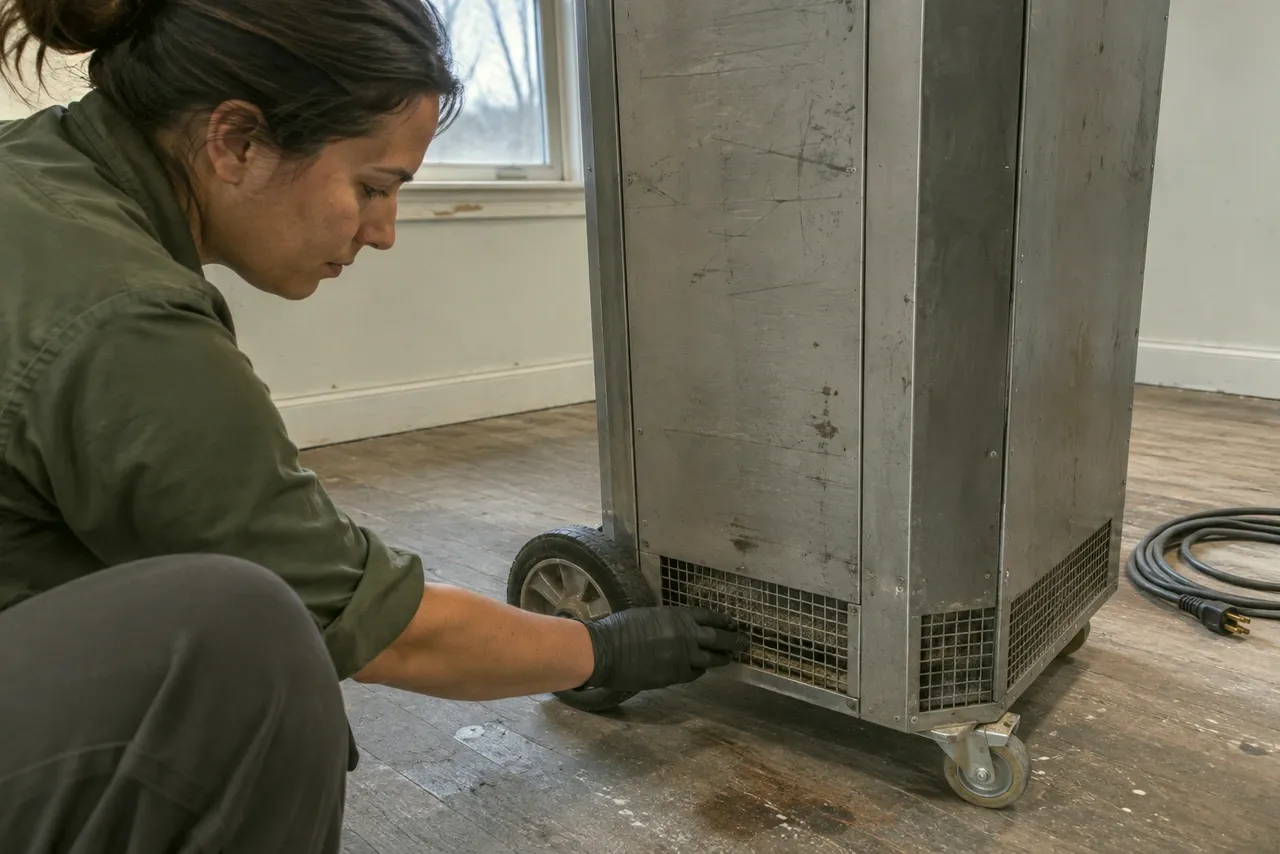
Cold does not end a bed bug problem inside a heated Warren house. Michigan's bed bug manual says they survive freezing temperatures for days and much lower ones for short periods, so a garage or porch in January rarely kills them all. Inside, winter means closed windows, more time at home and holiday guests sleeping on couches and air mattresses, which can spread bugs from one room to another. Because bed bugs die at about 120°F, heat remains effective in any month; see how bed bug heat treatment works in Warren homes, or how chemical treatment handles cracks and furniture. Renters in shared buildings face extra winter risk from neighboring units; our page on apartment bed bug treatment covers how adjoining units are checked.
Found bites after a trip or holiday visit?
One call connects you with an independent Warren-area provider who can inspect, confirm the pest and explain your treatment options.
10. Winter Rodent Invasion Statistics for Michigan and Warren
Rodents invade an estimated 21 million U.S. homes each winter, according to the National Pest Management Association, and 24% of homeowners report mice infestations specifically in winter (NPMA). The figure often quoted as "21+ million" is NPMA's estimate of about 21 million. In the Warren area, the trigger for that move indoors comes on a predictable schedule: NOAA's normals put the median first freezing night at Detroit Metro Airport on October 27.
| Winter rodent metric | Value | Source |
|---|---|---|
| U.S. homes invaded by rodents each winter | about 21 million | NPMA |
| Homeowners reporting mice infestations in winter | 24% | NPMA |
| Earliest first freeze, 1 year in 10 (DTW) | October 14 | NOAA NCEI |
| Median first freeze, 32°F (DTW) | October 27 | NOAA NCEI |
| Median first hard freeze, 28°F (DTW) | November 7 | NOAA NCEI |
| First freeze has come by, 9 years in 10 | November 9 | NOAA NCEI |
| Median last spring freeze (DTW) | April 20 (after May 8 in 1 year in 10) | NOAA NCEI |
| Freezing nights: November / December / January | 13.7 / 24.2 / 27.2 | NOAA NCEI |
| Detroit rank, Orkin Rattiest Cities 2026 | #6 | Orkin |
| Gap a mouse can fit through | 1/4 inch, the width of a pencil | CDC |
| Americans who call a pro at the first sign of rodents | 17% | NPMA / Harris Poll |
| Americans aware rodents can transmit disease | 43% | NPMA / Harris Poll |
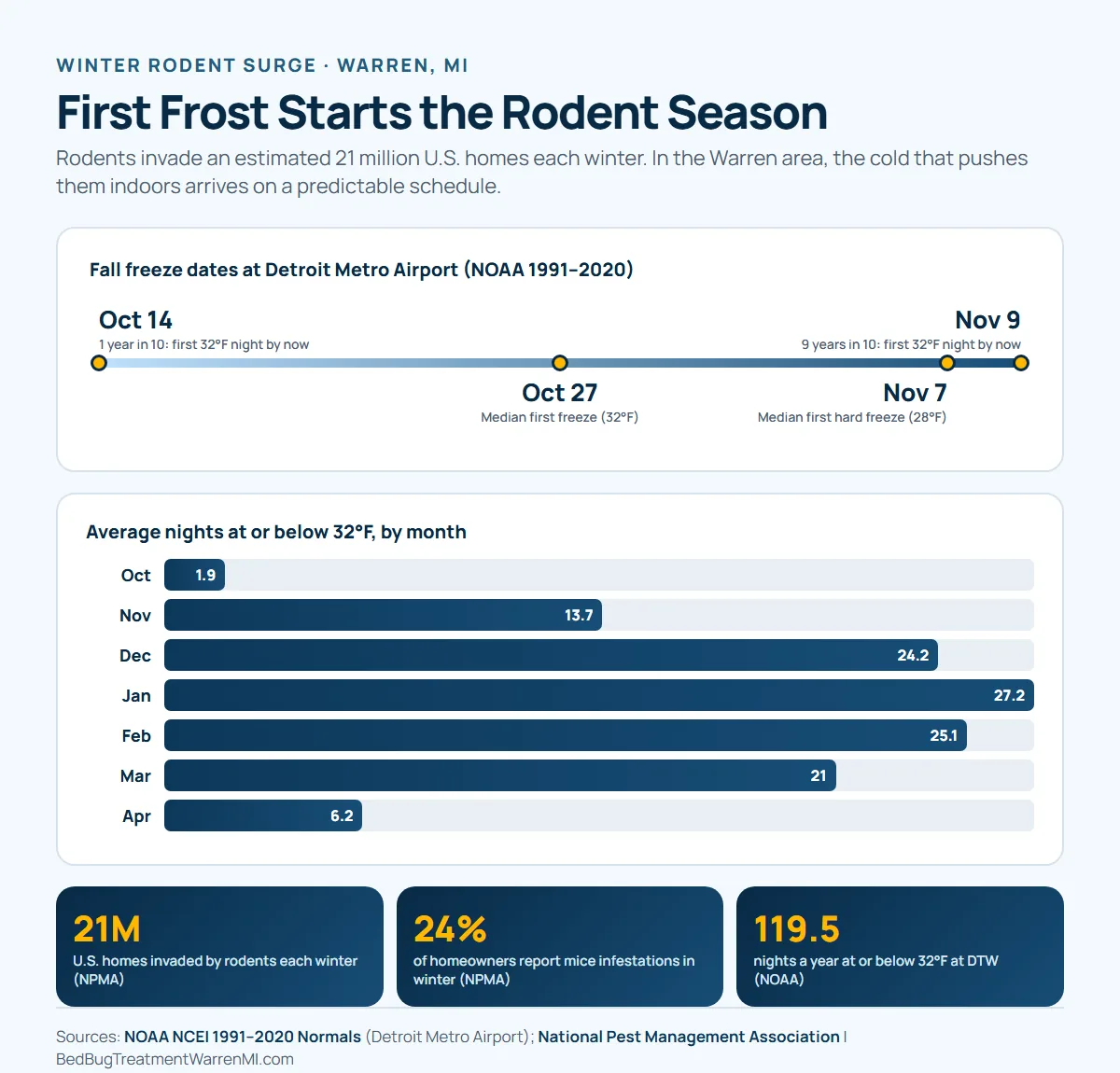
Read together, the numbers give Warren a rodent calendar. Late September and early October are the time to seal gaps, because a mouse needs only a quarter-inch opening and the first freeze can arrive by mid-October. From November, when the area averages almost 14 freezing nights, through March, rodents that got in stay in. Terminix's entomologist notes that milder falls can extend breeding before the cold arrives and push more rodents indoors when it does (PCT). Our cost index lists Detroit-metro rodent treatment at $190–$630 per job.
11. A Season-by-Season Pest Checklist for Warren Homes
Turning the calendar into action, here is what the data suggests checking in each season. None of it replaces an inspection when you already have a problem.
| Season | Main pests (per the matrix) | What to check |
|---|---|---|
| Spring (Mar–May) | Termite and ant swarms, ticks, stink bugs leaving, bed bug calls | Identify any indoor swarm; check beds after winter travel and when winter bedding comes off |
| Summer (Jun–Aug) | Mosquitoes, ticks, bed bugs from travel | Empty standing water weekly; inspect luggage after trips; check yard-sale furniture outdoors |
| Fall (Sep–Oct) | Yellowjackets, fall invaders, first rodents | Seal gaps of 1/4 inch or more before mid-October; watch for nests near doors |
| Winter (Nov–Feb) | Mice and rats indoors, bed bugs from holiday guests | Check guest beds and couches after visitors leave; watch for droppings and gnawing |
Bed bug checks apply in every season. Older homes in the Warren Village historic district and ranch houses in Balmoral Park share the same calendar, and our neighborhood pages describe how bed bug work is planned for each. If a treatment has already been done, a follow-up visit is the right time to confirm nothing hatched afterward.
Summary Table: Warren Seasonal Pest Statistics at a Glance
| Statistic | Value | Source |
|---|---|---|
| Annual mean temperature, DTW | 50.6°F | NOAA NCEI |
| Median first fall freeze / last spring freeze | Oct 27 / Apr 20 | NOAA NCEI |
| Freezing nights per year | 119.5 | NOAA NCEI |
| Months with mean 50°F+ (mosquito flight) | May–October | NOAA NCEI |
| Peak West Nile risk, Michigan | August–September | MDHHS |
| Human West Nile cases, Michigan / Macomb, 2026 | 35 / 5 | MDHHS |
| Mosquito control, per visit / per season | $80–$150 / $350–$1,000 | HomeGuide |
| Blacklegged tick season, Michigan | March–November | MDHHS |
| Michigan Lyme cases, 2024 | 1,215 (+168% since 2020) | MDHHS |
| Macomb County Lyme cases, 2025 | 21 | Macomb County |
| Termite swarm window, Michigan | March–May | Orkin |
| Yellowjacket peak | Early September, 800–3,000 workers | MSU |
| U.S. homes invaded by rodents each winter | about 21 million | NPMA |
| Detroit: bed bugs / mosquitoes / rats (Orkin 2026) | #3 / #4 / #6 | Orkin |
| Busiest bed bug season per pest pros | Spring (43%) | PCT |
| Bed bug report peak / low (Philadelphia) | August / February | Mabud et al. |
Methodology & Sources
This calendar was compiled in November 2026. Climate figures are NOAA's official 1991–2020 U.S. Climate Normals for Detroit Metro Airport (station USW00094847), the nearest long-record NOAA station to Warren, pulled from NOAA NCEI's data service. Monthly relative humidity is our calculation: the average of hourly humidity derived from NOAA's hourly temperature and dew point normals. Pest activity windows come from state and county health agencies, Michigan State University and pest industry surveys; the pressure levels in the matrix are our reading of those windows, not measured counts. Cost figures are published third-party ranges, and the Warren mosquito season estimate is a labeled calculation. Mosquito programs are often quoted at $350–$700 a season and $75–$150 a visit; the current cost guides we checked put them at $350–$1,000 and $80–$150, so we used those. Rankings reflect the treatment data of individual pest companies and are not government statistics.
- NOAA NCEI, U.S. Climate Normals 1991–2020 (Detroit Metro Airport)
- MDHHS, Weekly Arbovirus Summary, Michigan 2026
- MDHHS, First 2025 West Nile detection
- MDHHS, Tick season 2025
- MDHHS, Michigan Lyme Disease Risk Map (2026)
- Michigan Bed Bug Manual
- Macomb County Health Dept., Ticks and Lyme disease (2026)
- Macomb County Health Dept., Ticks and Lyme disease (2024)
- Macomb County, Tick surveillance
- Macomb County, West Nile virus surveillance
- Michigan Public, Mosquito season extending (2025)
- MSU Extension, Mosquito super emergence
- MSU, Yellowjackets
- MSU Extension, Fall house-invading insects
- MSU IPM, Brown marmorated stink bug
- MSU Extension, Carpenter ants
- MSU Extension, Brown recluse
- MSU Entomology, Michigan spider list
- Orkin, 2026 Bed Bug Cities
- Orkin, 2026 Mosquito Cities
- Orkin, 2025 Mosquito Cities
- Orkin, 2026 Rattiest Cities
- Orkin, Termites in Michigan
- PCT, Terminix rodent cities
- PCT, Bugs Without Borders 2025
- Professional Pest Management Alliance, survey release
- NPMA, Bed bug facts and statistics
- NPMA, Winter pest-proofing
- NPMA, Rodent Awareness Week release
- CDC, Seal up rodent entry points
- Mabud et al., Bed bug reporting in Philadelphia (2014)
- HomeGuide, Mosquito control cost
- Angi, Mosquito control cost (2026)
- AAA, Year-end holiday travel forecast 2025
- AAA, Thanksgiving travel forecast 2025
- Wayne County Airport Authority, DTW 2025 statistics
Warren Seasonal Pest FAQ
What are the most common pests in Warren, MI?
Going by national treatment rankings for the Detroit metro, the biggest problems are bed bugs (Detroit is #3 on Orkin's 2026 list), mosquitoes (#4) and rats and mice (#6). Seasonally, Warren homes also deal with ticks, termite and ant swarms in spring, yellowjackets in late summer and stink bugs and lady beetles in fall.
When is mosquito season in Michigan?
Mosquitoes fly whenever it is 50°F or warmer. Near Warren the monthly mean is above 50°F from May through October, and Michigan's West Nile risk peaks in August and September.
When is tick season in Michigan?
Blacklegged ticks are active from March to November in Michigan, and Macomb County says Lyme disease is usually passed on between April and September. Michigan recorded 1,215 Lyme cases in 2024, up 168% from 2020.
When do termites swarm in Warren?
Michigan's eastern subterranean termites typically swarm during the day from March to May, usually on a warm day after rain. Near Warren, April and May are the likeliest weeks, since March averages only about 37°F.
How many homes do rodents invade in winter?
The National Pest Management Association estimates rodents invade about 21 million U.S. homes each winter. Near Warren the median first freeze is October 27, so sealing gaps by mid-October is the practical deadline.
How much does mosquito barrier treatment cost?
Cost guides put a mosquito control visit at $80–$150 and a full season at $350–$1,000. Barrier sprays alone run about $70–$165 per treatment depending on the source and yard size.
Is there a bed bug season in Michigan?
Bed bugs live indoors and feed all year, but reports rise and fall. City data from Philadelphia peaked in August and dipped in February, and 43% of pest professionals now name spring their busiest bed bug season, often after holiday travel.